Farbound for iPhone
The sky
is a place.
Stand at Tranquility Base. Split Betelgeuse's light into its true spectrum. Raise your phone and the real night sky lines up with where you stand.
Download on the App StoreFree to explore. Farbound Core unlocks the core collection. Future content packs may be sold separately.
01 · The Star Catalog
A catalog with a soul
Every star in Farbound has its own page: its story, its numbers, its place in the sky. And every page opens into the star's own light. Tap "Read its light" and the Spectrum Lab draws that star's true spectrum, absorption lines and all, with the dial parked on its real surface temperature.
Betelgeuse blazes at 3,600 kelvin. The app shows you what that means, in the star's own colors.
Get the appBetelgeuse
The dying red giant that will one day outshine the Moon
How big is that?
Every scale model of the solar system you have ever seen gets destroyed by Betelgeuse. Put the star where the Sun is. Mercury is gone, swallowed. Venus, gone. Earth, gone, along with the Moon and every photo ever taken of it. Mars, gone. The asteroid belt orbits inside the star. Betelgeuse's surface would reach most of the way to Jupiter, some 700 to 800 times the Sun's radius. Light itself, the fastest thing in the universe, would need well over half an hour just to travel from one side of Betelgeuse to the other. And here is the detail that should keep you up at night in the best way: all that immensity is wrapped around a core the size of a small city, frantically fusing its way toward iron, and toward the most spectacular explosion our sky is ever likely to see.
α Ori
58 Orionis
HR 2061
HD 39801
HIP 27989
The Ember on the Hunter's Shoulder
Look at Orion on any winter evening and one star breaks the pattern. The hunter's outline is drawn in icy blue-white points, Rigel at his foot, Bellatrix at one shoulder, the belt stars Alnitak, Alnilam, and Mintaka cinched across his waist. And then, at the upper left corner, there is Betelgeuse, glowing distinctly orange-red, like a coal that rolled into a case of diamonds. You do not need a telescope to see the color. You barely need to pay attention. That redness is a temperature reading: Betelgeuse's surface is a mere 3,600 kelvins, cool for a star, which shifts its light toward the red end of the spectrum. Watch it across seasons and years and you will notice something else. Betelgeuse does not hold steady. It brightens and fades noticeably, wandering between about magnitude 0.0 and 1.6, the widest swing of any first-magnitude star. It is one of the few stars whose variability you can track with your naked eye and a little patience, a giant heartbeat you can watch from a parking lot.
A Star at the End of Its Rope
Betelgeuse is a red supergiant, which is not a type of star so much as a stage of dying. It began its life only about eight to ten million years ago as a blazing hot blue star, probably 15 to 20 times the Sun's mass, similar to what Rigel is now. Then it burned through the hydrogen in its core, and everything changed. The core contracted and heated; the outer layers responded by ballooning outward to absurd dimensions, around 764 times the Sun's radius, while cooling to that signature ember color. The star now shines with something like 100,000 Suns of total power, most of it in infrared light your eyes cannot see. Deep inside, it has moved on to fusing helium into carbon and oxygen, working its way up the periodic table with mounting desperation. Every stage of fusion buys less time than the one before. Hydrogen fed the star for millions of years. The final act, fusing silicon into iron, will last about a day. Betelgeuse is not middle-aged. It is in the last one percent of its life, and possibly the last sliver of that.
Boiling in Slow Motion
Betelgeuse was the first star other than the Sun to have its physical size measured directly, by interferometry back in 1920, and it has been humbling astronomers ever since. It is so large and so distended that its edge is genuinely hard to define. The 'surface' is a vague, seething haze that varies depending on the wavelength you observe, and the star is not even round: images show a lumpy, asymmetric blob. The reason is convection gone monstrous. On the Sun, hot gas rises in granules about the size of Texas, millions of them tiling the surface. On Betelgeuse, models and images suggest the surface may be dominated by just a handful of colossal convection cells at a time, each one a rising plume of gas potentially wider than the entire Sun's orbit-crossing neighborhood, ascending and sinking over months and years. The star is boiling, visibly, in slow motion. Those vast bubbles, along with the star's slow pulsations, are why its brightness wanders so much. When you see Betelgeuse flicker over the months, you are watching continent-sized weather on a star, except the continents are bigger than stars.
The Hand of the Central One
Betelgeuse may be the most famous star name in the sky and one of the most mangled. It descends from the Arabic yad al-jauza, 'the hand of al-Jauza,' al-Jauza being a mysterious central figure, possibly a woman, that early Arab skywatchers saw in this part of the sky. Medieval scribes transliterating Arabic into Latin misread the first letter, and after centuries of copying errors the name drifted to 'Betelgeuse.' The star marks the raised hand or shoulder of Orion in the Greek tradition, and it carries the designation Alpha Orionis even though Rigel, the Beta star, usually outshines it, a quirk possibly explained by Betelgeuse having been caught near maximum brightness when the letters were assigned in 1603. Cultures everywhere noticed this star. In Australia, some Aboriginal traditions tracked its varying brightness centuries before European astronomers formally recognized it as variable. And yes, the 1988 movie leaned into the pronunciation 'Beetlejuice,' which astronomers have mostly stopped fighting. Say it that way if you like. The star has survived worse than a comedy; it is currently surviving its own death.
The Great Dimming
In late 2019, Betelgeuse did something that made the whole world look up. Over a few months it faded dramatically, dropping to around magnitude 1.6 by February 2020, roughly a third of its usual brightness and the dimmest it had been in over a century of records. Orion looked wrong, like a face missing an eye. Speculation went viral: was the star about to explode? Telescopes worldwide swung toward it, and the Very Large Telescope in Chile captured astonishing before-and-after images showing the star's southern half shrouded and dark. The verdict, assembled over the following two years, was almost better than a supernova. Betelgeuse had burped. The star ejected a massive bubble of hot gas from its surface; as that material drifted outward and cooled, it condensed into fine dust, and the dust cloud eclipsed part of the star as seen from Earth, likely aided by a cool patch on the surface itself. By mid 2020 the veil dispersed and Betelgeuse recovered. For astronomers it was a gift: a front-row view of how a dying supergiant sheds itself into space, one titanic exhalation at a time.
The Explosion on Layaway
Betelgeuse will explode. That is not speculation; it is the standard fate of a star this massive, and every measurement says the fuse is already burning. When the core finally forges iron, fusion stops paying the bills, gravity wins in milliseconds, and the collapsing core rebounds in a Type II supernova that will briefly outshine ten billion Suns. From Earth, about 550 light-years away, the show will be unforgettable and, importantly, safe; that distance is far outside the danger zone. The supernova would blaze roughly as bright as a quarter Moon or more, concentrated in a single blinding point, casting shadows at night and shining plainly in daytime skies for weeks before fading over months. Orion's shoulder would burn out, leaving the hunter maimed for eternity, with only Saiph and Rigel and Bellatrix to hold the pattern together. When? Astronomers' best answer is 'soon,' by which they mean sometime in the next hundred thousand years or so, possibly tomorrow. And because the star is 550 light-years away, there is a real chance it has already happened, and the light announcing it is somewhere between here and there, on its way.
The Runaway With a Bow Wave
Here is the plot twist hiding in Betelgeuse's biography: it is a runaway. Trace its motion backward and the star appears to have been born in the great Orion OB1 stellar association, the same sprawling family that produced the belt stars Alnitak, Alnilam, and Mintaka. Something, perhaps a gravitational slingshot among sibling stars or the supernova kick of a former companion, hurled Betelgeuse out of its birthplace, and it has been plowing through space at roughly 30 kilometers per second ever since. Infrared space telescopes photographed the consequences: an enormous curved bow shock, a wave of compressed gas and dust arcing ahead of the star like the wake before a ship's prow, spanning light-years. Betelgeuse is a fugitive dragging a shroud, having already exhaled more than a Sun's worth of its own mass into a nest of nested shells around it. There is even evidence, published in the 2020s, that Betelgeuse may have a small companion star orbiting within its outer layers' reach, faithfully circling a star that is about to erase it. The doomed orbiting the doomed: the universe writes better drama than we do.
Gallery
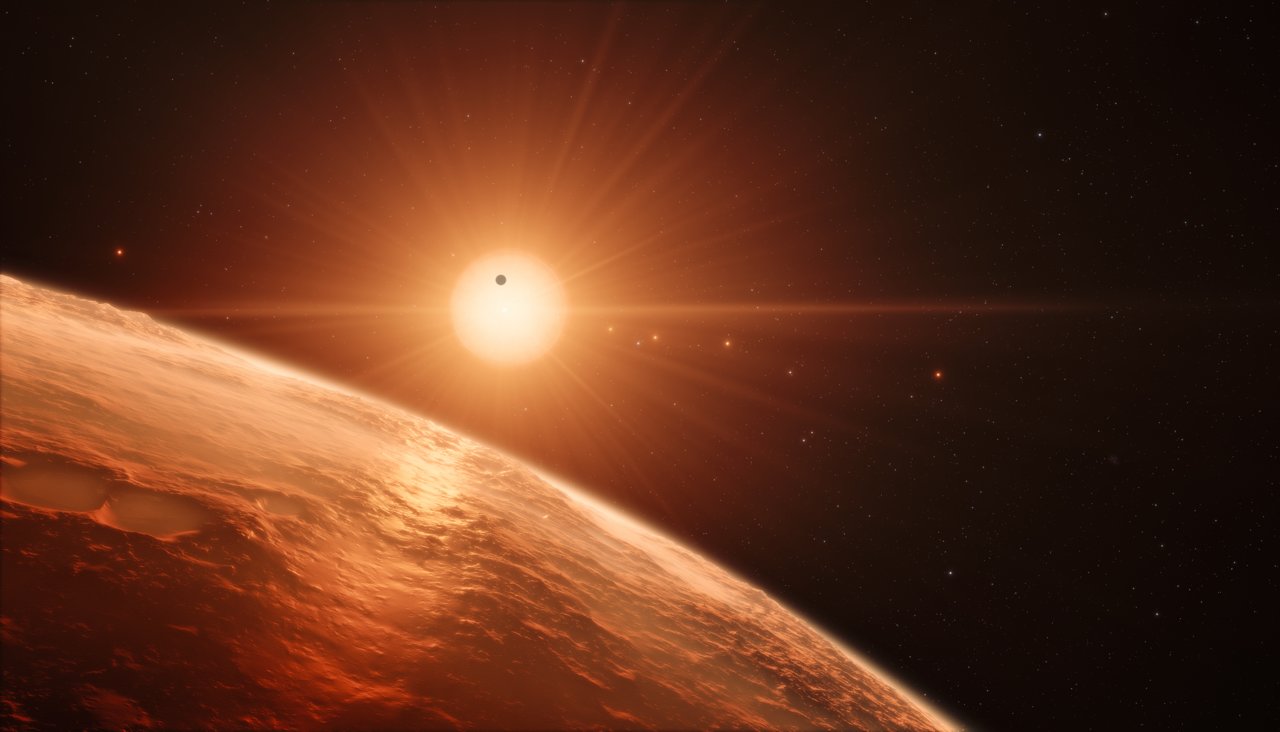
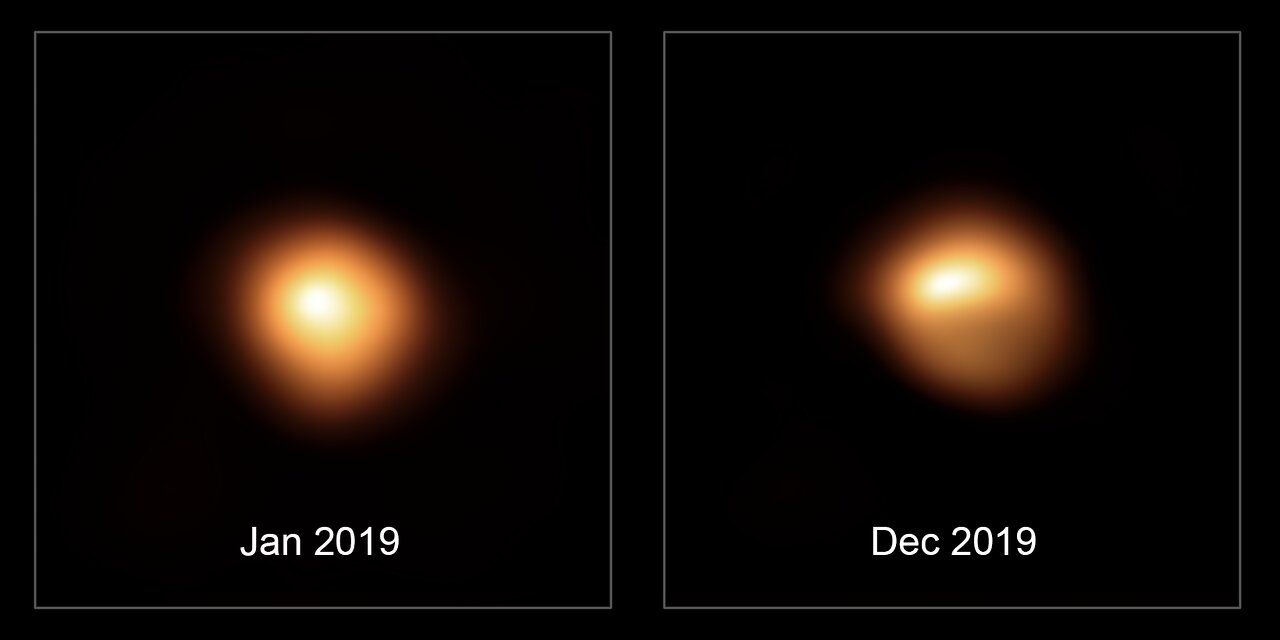
Source: Jim Kaler, Stars (University of Illinois), NASA, ESA, Hipparcos
02 · The Spectrum Lab
Split starlight with your thumb
Pull a star's light apart into a rainbow and find the dark lines standing in it: elements in the star's own skin, each swallowing one color. Turn the temperature dial and watch elements wake and vanish as the surface heats from ember red to furnace blue.
Then the game begins: six real stars arrive unnamed, and you unmask each one by nothing but its lines.
This one is real. The dial on the right runs the app's actual physics. Try it.
Get the app5,800 K
03 · Gravity Sculptor
Sculpt with gravity
Drag empty space and a star is born, moving. Then release three thousand particles and watch gravity comb them into rings, spirals and tails around the worlds you place. Every one is an N-body simulation running under your thumb.
Nothing to solve, nothing to win. A zen garden made of orbits, and it answers every touch.
Get the app04 · Interactive Stories
Earth's whole story, read aloud
The Long Before carries you from the cloud that made the Sun to the shore you know, in forty-four narrated chapters. Swipe the deep time here, and press play to hear the first four read aloud, a free preview of the full story.
A second story follows a massive star through its life, collapse and explosion, in a little over two minutes.
Get the app05 · The Celestial Compass
The sky above you, aligned
Raise your phone and the real stars line up with where you point, computed for the spot you are standing on. Search any object and it pings in the sky so you know exactly where to aim your binoculars.
Get the app06 · Sounds From Space
Hear a black hole
Real recordings and honest sonifications, labelled so you always know which is which. One of them is the pressure wave of the Perseus black hole, a true sound in the thin hot gas of a galaxy cluster, 57 octaves below middle C.
Get the app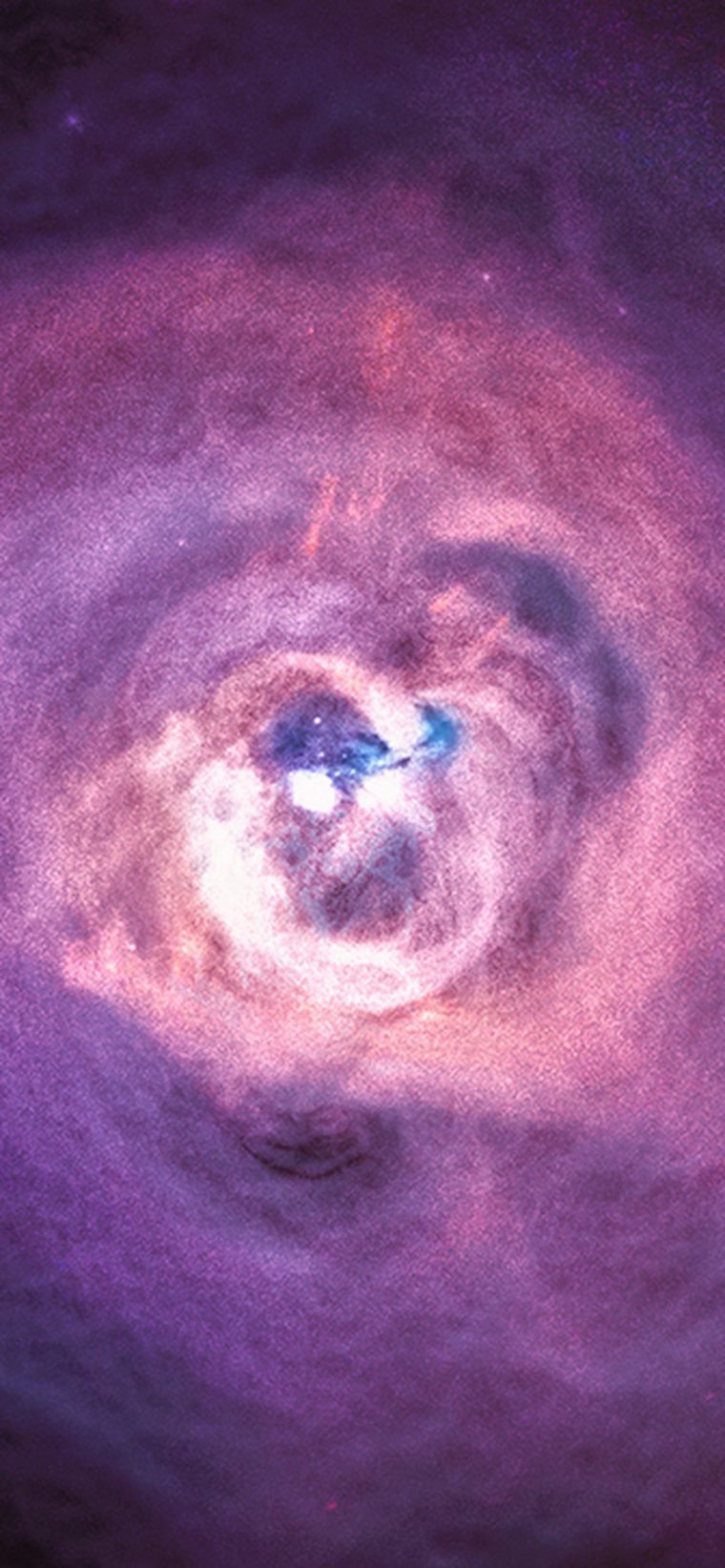
07 · Sky Events
Never miss what's overhead
A live calendar of eclipses, meteor showers and planet alignments, each rebuilt as a scene you can watch. See the date, the best hour to look up, and add it to your own calendar in one tap — so the next event finds you.
Get the appFree on the App Store
Come see the sky
as a place.
The Compass, all 921 stars and the first part of every experience are free, with no ads and no account. Farbound Core is a one-time purchase that permanently unlocks the core collection. Future optional content packs may be sold separately.
Download Farbound